 Search Tips
Overview
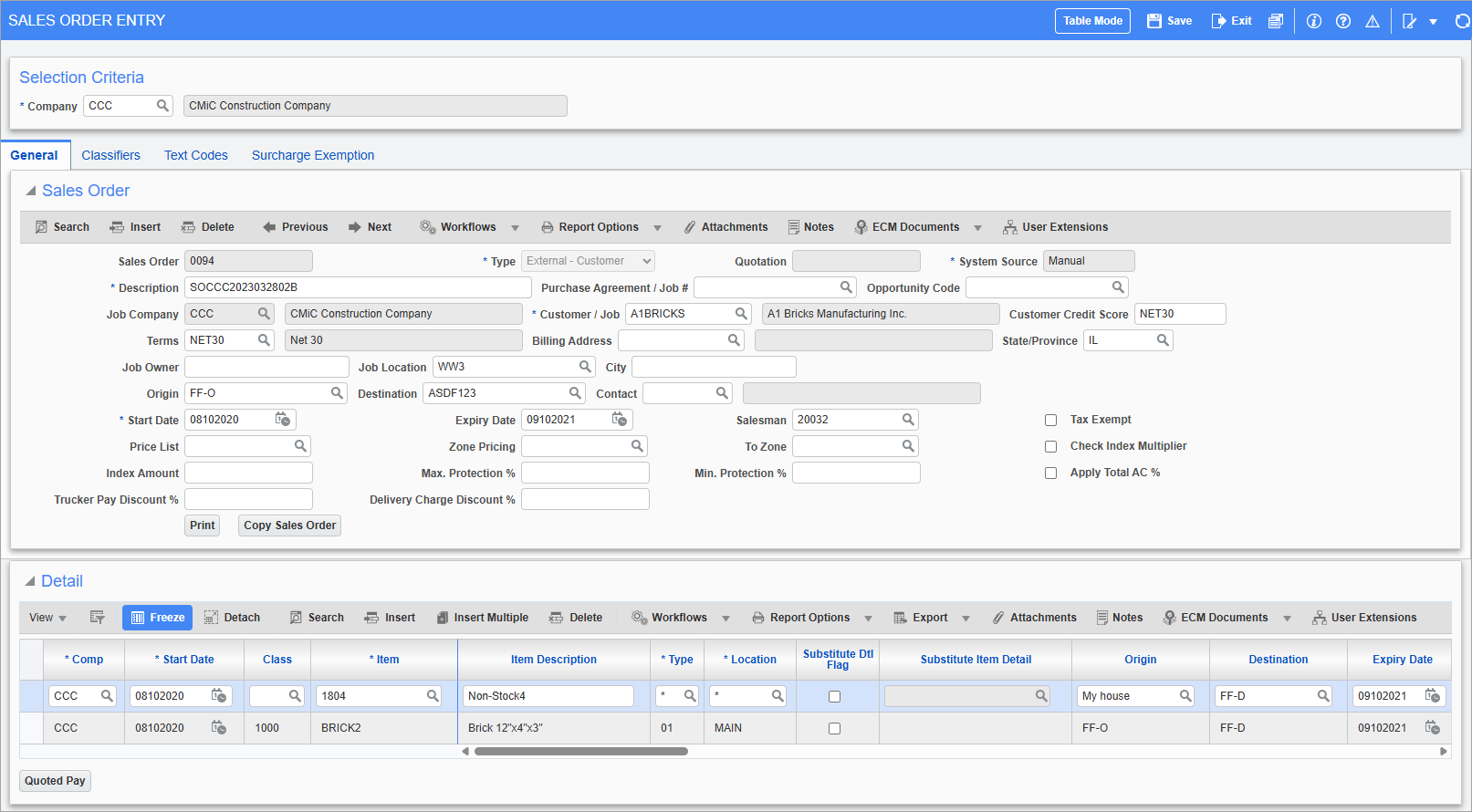
Pgm: MS_SALES_ORDER_ENTRY – Sales Order Entry; standard Treeview path: Material Sales > Sales Order > Sales Order Entry
The Sales Order Entry screen may be used to enter or edit a sales order whether that sales order is entered manually, imported, or copied from a quotation.
Selection Criteria
Company
Enter the company code for the sales order type.
General – Tab
Sales Order
Enter the sales order code and description.
Type
Select the customer type. To create an external quotation, set the Type field to “External – Customer”. For internal quotation, the Type field should be set to “Internal – Job”.
Purchase Agreement/Job #
Enter the PO/job number associated with this customer. This is a free-form text which is customer defined.
Opportunity Code
This LOV lists the opportunities for the customer denoted in the sales order. Any opportunity selected is used for informational purposes only.
Customer/Job
Enter the customer code.
Terms
Select the payment terms for this customer. This will default from the customer’s payment terms defined in AR.
Billing Address
If there is an alternate address to be used for billing, select it from the LOV. The LOV will show the additional addresses associated with the customer.
Job Owner
Enter the name of the job owner.
Job Location
Enter the job location. This is usually the job site.
City
Enter the city where the job will be located.
Origin
Enter the origin. The origin is usually the material production site, such as a plant or quarry, but it may be a job site. The origin is not a mandatory field as it may not be known at the time the quotation is entered.
Destination
Enter the destination. This field defaults from the job location. The destination is usually a job site but the quotation may be issued for hauling from a job to a dump, etc.
Contact
Enter the contact.
Start Date
Enter the start date of the quotation.
Expiry Date
Enter the expiry date of the quotation.
Salesman
Enter the salesman’s employee number.
Tax Exempt – Checkbox
Check this box if the quotation/sales order is exempt from tax.
Price List
Enter/select a price list.
Zone Pricing
Enter/select zone pricing.
To Zone
Enter/select a to zone.
Check Index Multiplier – Checkbox
Check this box to apply APADot method to calculate the AC price adjustment.
Index Amount
Enter the index amount.
Max Protection %
Enter the maximum protection percentage.
Min Protection %
Enter the minimum protection percentage.
Apply Total AC % – Checkbox
Check this box to use the Total AC % defined on the composite item itself.
Trucker Pay Discount %
Enter the trucker pay discount.
Delivery Charge Discount %
Enter the delivery discount percentage.
[Notes] – button
Notes may be entered using the [Notes] button on the Block Toolbar for information regarding the whole quotation. Notes are for internal use and will not print on the quotation.
[Print] – Button
Use the [Print] button to print the sales order currently on the screen.
[Copy Sales Order] – Button
A sales order can be copied to another quotation by clicking the [Copy Sales Order] button. A prompt is displayed for the new sales order code. Once the new code is entered, a new sales order is created with the same data as the sales order from which it was copied.
Classifiers – Tab
If the company has set up classifiers, enter the required information on this tab.
Text Codes – Tab
This tab is used to enter text codes. This information will print in the header of the sales order.
Surcharge Exemption – Tab
This tab is used to enter surcharge codes if they need to be exempted.
Detail
This section lists all the items included in the sales order.
Comp
Enter company code.
Start Date
Enter the start date for the specific material for a price list lookup. This date should be on or after the start date of the quotation.
Class
Class is for an inventory item only. If an inventory item is being quoted, a class must be entered.
Item
Select the item from the LOV. If a class has not been entered the item selection will be limited to purchase order non-stock items or Accounts Receivable non-stock items. The item code will play a key role in the search of the customer price list’s unique combination of item, location, type, and weight measure code. When using a non-stock item from either Purchase Order or Accounts Receivable, the only two combinations required are item and weight measure code.
Type
Type is for an inventory item only. The type may play a key role in the search of the customer price list’s unique combination of item, location, type, and weight measure code. If the item is a non-stock item, the field will populate with an asterisk when the user tabs past it.
Location
Select the item location.
Substitute Dtl Flag – Checkbox
Check or uncheck the substitution flag if applicable.
Origin
Enter the origin of the job.
Destination
Enter the destination of the job.
Expiry Date
Enter the expiry date.
Total AC %
Enter the override AC percentage.
Index Amount
Enter the selling price index amount.
Max Protection %
Enter the maximum protection percentage.
Min Protection %
Enter the minimum protection percentage.
Quantity
Enter the quantity being quoted.
WM
Enter the weight/measure code being quoted. The weight/measure code will play a key role in the search of the customer price list’s unique combination of item, location, type, and weight/measure code. When using an AR non-stock or PO non-stock item, the only two combinations required are item and weight/measure code.
Price
The price will default from the customer price list search by item and default order for an item in the price list. The price can be overwritten in the quotation price field.
Amount
The amount will be calculated as price × quantity.
Disc%
Enter the discount percent on the amount if not entering a discount per WM.
Disc/WM
Enter the discount per WM if not entering a discount percent. This is the discount dollar amount for every unit of WM entered as the quantity.
Zone Pricing
Enter the zone pricing code to be applied to the quotation.
From Zone, To Zone
Enter the range of zone codes to be applied to the quotation.
Tax1, Tax2, Tax3
Enter the tax codes to be applied to the quotation.
Trucker Class
Enter the trucker vendor class code if applicable.
Truck Class
Enter the truck class code if applicable.
Pay Rate
Enter the pay rate to be paid to the trucker for delivery of the item. The trucker may be an internal trucker or external trucker including sub-haulers. Pay rate should be entered only if the trucker is an external trucker or sub-hauler.
Min Pay Qty
Enter the minimum pay quantity.
Min Pay Amount
Enter the minimum pay for truckers.
Trucker Pay
This displays the trucker pay.
Trucker Pay Surcharge %
Enter trucker pay surcharge percentage.
Pay Surcharge Rate
Enter trucker pay surcharge per WM.
Pay Lump Sum Amount
Enter the pay lump sum amount.
Trucker Pay Surcharge
This displays the trucker pay surcharge.
Delivery Charges Rate
Enter the delivery charges per WM.
Min Charges Qty
Enter the minimum quantity required for delivery.
Min Charges Amount
Enter the minimum charge required for delivery.
Delivery Charges
This displays the delivery charges.
Delivery Surcharge %
Enter the delivery surcharge percentage.
Charges Surcharge Rate
Enter the delivery surcharge rate per WM.
Lump Sum Amount
Enter the delivery surcharge lump sum amount.
Delivery Charges Surcharge
This displays the delivery charges surcharge.
Bid Margin
Enter the bid margin for the quote item.
Delivery Charge Tax1, Tax2, Tax3
Enter the delivery charge taxes.
Delivery Surcharge Tax1, Tax2, Tax3
Enter the delivery surcharge taxes.
[Quoted Pay] – Button
Press this button to launch the Quoted Trucker Pay pop-up to enter the quoted trucker pay rates and minimum amounts.